
What Happens During an Electrical Switchboard Upgrade?
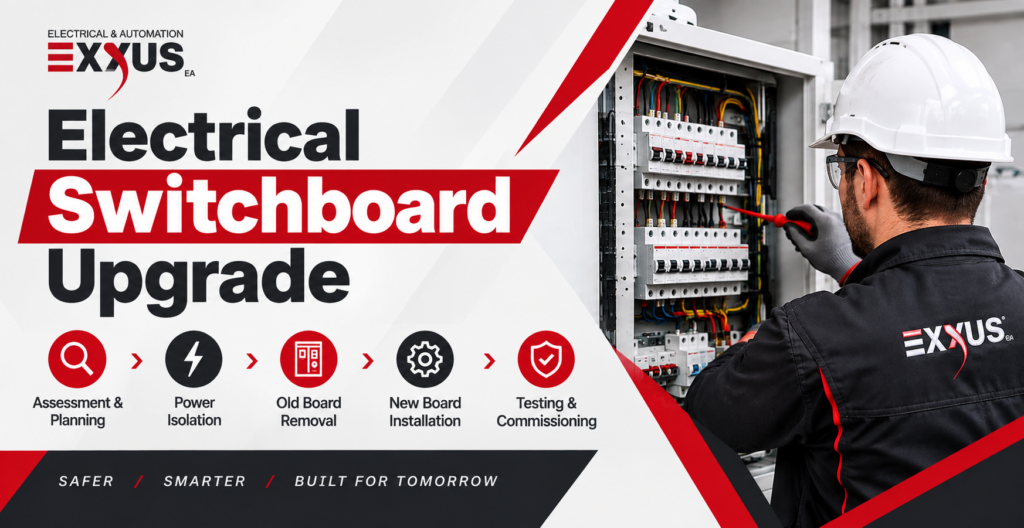
If your home needs an electrical switchboard upgrade, you’re probably wondering what’s actually involved. It’s more than just swapping an old box for a new one. An electrician will check your existing switchboard, safely turn off the power, remove or upgrade parts as needed, reconnect the circuits, and run thorough safety tests before switching the power back on.
For homes with outdated or overloaded switchboards, an upgrade helps reduce the risk of fire and shock. It also brings your electrical system up to current safety standards and supports the power needs of modern appliances, plus whatever you’re planning to add down the track. If you’d like to see the kind of work this involves, our gallery has examples of completed jobs.
This guide covers what a switchboard actually does, the signs that you might need an upgrade, the step-by-step process, what to expect on the day, how long it takes, typical costs, and a few important safety and planning points along the way.
Quick Overview: What Happens on Upgrade Day?
The upgrade follows a fairly clear sequence. It starts with a consultation, where an electrician inspects your switchboard, gives you a quote, and books in the work.
On the day itself, the main steps are a safety check, turning off the power, removing the old switchboard or fuse box, installing the new switchboard and protective devices, reconnecting circuits, testing and labelling everything, and handing over compliance documents.
A typical residential upgrade with 8 to 12 circuits usually takes somewhere between 4 and 8 hours. Simpler jobs can be done in 2 to 3 hours. The exact time really comes down to the condition of the wiring, how many circuits there are, and whether any extra work turns up along the way.
Testing happens once everything’s installed, and a compliance certificate is issued once it all passes. Power will be off for most of the job, but it’s restored once testing is done.
What Is an Electrical Switchboard and Why Does It Matter?
Your electrical switchboard is where electricity enters your home and gets distributed out to the different circuits. It holds the safety devices that protect against overloads, short circuits, and earth faults. Modern switchboards improve on this by replacing old fuses with circuit breakers and safety switches, like RCDs or RCBOs, which detect faults faster and offer better protection against shock.
Older homes, especially ones with an old electrical switchboard or an outdated switchboard and without safety switches, often need a closer look if you’re adding a high-demand appliance like ducted air conditioning, an induction cooktop, or an EV charger.
These older setups may not handle modern electrical loads well, so higher-demand additions can quickly expose the limits of equipment not designed to handle modern electrical loads. Age on its own doesn’t decide whether a switchboard needs replacing; that’s really a job for a professional assessment from one of our licensed electricians.
Modern switchboards are simply built to handle today’s higher power demands more comfortably in a modern home.
Signs You Might Need a Switchboard Upgrade
There are a handful of warning signs that mean it’s worth getting a professional to check your switchboard. These include circuit breakers that trip often or fuses that blow, overloaded circuits, a burning or overheating smell near the board, scorch marks or a panel that feels warm, buzzing noises, lights flickering across multiple rooms, ceramic fuses instead of circuit breakers, missing safety switch test buttons, and covers that are damaged or missing on metal switchboards. Left alone, these issues can create serious safety risks, including electrical fires and electrical faults.
Adding a high-power appliance, think ducted air conditioning, solar panels, or an EV charger, can also mean it’s time for an upgrade. Homes built before 1990 tend to need one, since older systems were often built without today’s safety features and can be a source of these risks. Modern switchboards are designed to comfortably meet current household power needs.
How Long Does a Switchboard Last?
With decent installation and a bit of care, a modern switchboard can last for decades. That said, if you start noticing electrical issues, it’s worth getting a professional to have a look.
Boards over 30 years old often need upgrading simply because of wear, outdated protection, and the fact that household electrical needs have moved on. If you smell burning, spot scorch marks, or your breakers keep tripping, get a licensed electrician out sooner rather than later, since an old board without modern protection can be a genuine fire hazard.
Electrical Switchboard Upgrade Requirements and Safety Standards
Upgrades need to meet Australian Standards (AS/NZS 3000), local wiring rules, and the requirements of your electricity distributor.
A few of the key points:
- Proper earthing and bonding
- Correct circuit protection against overloads and earth faults
- Safety switches fitted on required circuits, mandatory in many states since the early 1990s, to protect power circuits by disconnecting dangerous faults
- Equipment rated for the expected fault current, so electrical current is managed safely
- Suitable enclosures and proper cable management
Electricians don’t just swap the box; they assess the whole installation, including existing wiring and whether the board is, or can be upgraded to, a compliant switchboard. As mentioned, boards over 30 years old often need upgrading because of wear, outdated protection, and changing demands. Common issues turned up during an assessment include:
- Ceramic fuses
- Missing covers
- Inadequate protection
- Asbestos backing boards
These all need a licensed professional to handle safely, which is exactly what our team is trained and equipped for.
Compliance paperwork varies a bit by state, but usually includes an Electrical Safety Certificate once the upgrade is done. In some cases, an upgrade is actually mandatory if it’s been flagged by your electricity distributor, Ausgrid for example.
This isn’t a DIY job. Only a licensed electrician can legally carry out switchboard upgrades and issue the certification that comes with them.
Step by Step: What Happens During a Switchboard Upgrade?
The process is thorough, and it’s tailored to both your home’s current needs and where you’re headed in the future.
Before the Electrician Arrives
The electrician inspects your switchboard, checks what your circuits need, looks at whether there’s room for extra circuits, and considers your plans and future appliances, including capacity for solar power systems and an EV charger, so the upgrade actually suits your plans, not just your current setup.
You’ll get a detailed quote explaining that switchboard upgrade costs vary depending on several factors, including materials, labour, and certification, and the work gets booked in at a time that suits you.
On Upgrade Day
The electrician starts with a safety check to make sure access is safe, then gets tools and protective gear ready. Power is turned off and confirmed off before the old board and its devices come out. If there’s asbestos backing involved, that’s handled with the appropriate care.
From there, the wiring and connections get checked, and new circuits may be installed where extra capacity is needed. Any cabling that’s damaged or undersized may be repaired or replaced. The new switchboard goes in, with room left for extra circuits based on what you’re likely to need down the line.
Protective devices, circuit breakers, RCD safety switches, and RCBOs are installed to the relevant safety standards, with safety switches monitoring for earth leakage and disconnecting supply during dangerous faults. Circuits are connected, then tested: operation, RCD trip, polarity, insulation resistance, and earthing are all checked off.
Everything gets clearly labelled so it’s easy to identify later, whether that’s for you or for the next electrician who works on it. The site is cleaned up, old equipment disposed of properly, and the compliance paperwork completed. The new safety devices themselves are designed to detect earth leakage and cut power within milliseconds if a fault occurs.
If the switchboard needs to be relocated, that can mean extra cabling and some wall repairs. A switchboard replacement, on the other hand, usually means swapping like for like where the existing unit is damaged but still compliant, rather than increasing capacity or changing the overall setup.
Old Ceramic Fuses vs Modern Safety Switches and Circuit Breakers
Older switchboards often still have ceramic fuses, small porcelain blocks with a replaceable strand of fuse wire inside. When the circuit is overloaded, that wire melts and breaks the connection. They look like small white or brown ceramic blocks, quite different from the toggle switches you’d see on a modern board.
The problem is that ceramic fuses react slowly, and if the wire is incorrectly rated, that can lead to overheating. Modern circuit breakers, RCBOs, and RCD safety switches disconnect a fault far faster, which helps prevent both damage and fires.
One thing worth flagging: replacing or increasing the fuse wire size just to stop fuses blowing is genuinely dangerous and should never be done. It strips out the protection that’s meant to be there and raises the fire risk. Depending on the condition of your board, some jobs will replace the hardware entirely, while others focus on expanding protection and circuit capacity.
Planning Your New Switchboard: Capacity, Circuits, and Future Needs
A well-planned switchboard should cover your current electrical needs while leaving room for whatever comes next.
Things worth thinking through:
- The number of existing circuits and the power load they carry
- Space for spare circuits
- Dedicated circuits for major appliances, ovens, air conditioners, hot water systems, kitchen appliances, and induction cooktops
- Circuits for EV chargers and solar inverters, with some planning for future appliances
- Equipment for pools, spas, or workshops
- Three-phase power, if that’s something you need
- Optional surge protection for sensitive electronics
- Smart monitoring technology for better energy management
Upgrading tends to improve efficiency too, by balancing loads and cutting down on wasted power, which can flow through to lower energy bills. Modern protection also boosts safety, with safety switches able to cut power in as little as 0.03 seconds when a fault occurs. Done properly, it means the home’s electrical system is ready for added demand without needing another upgrade again soon.
Our services page covers the full range of switchboard and electrical work we can plan around your needs.
How Long Does a Switchboard Upgrade Take and What Does It Cost?
Modern homes place different demands on a residential switchboard, so timing and price are affected by circuit count, the condition of the board, access, the state of the wiring, and whether the supply itself needs upgrading.
Typical timeframes:
- Basic upgrade (6 to 8 circuits): 4 to 6 hours
- Standard switchboard upgrade (10 to 12 circuits): 6 to 8 hours
- Complex work (15+ circuits, sub-board): 1 to 2 days
- Upgrade plus rewiring: 2 to 5 days
Costs generally range from around $1,200 for basic work up to $4,500 for a full job, but the switchboard upgrade cost can vary depending on several factors. In Brisbane specifically, most upgrades fall somewhere between $1,500 and $2,200. These include the board size and setup, your supply type, wiring condition, earthing, access, and how much load planning is involved. Rewiring, if it’s needed, can add another $4,000 to $10,000 on top.
It’s always worth getting a written, itemised quote that covers materials, labour, testing, and certification, with transparent pricing so there are no surprises later.
What to Expect on Upgrade Day
Plan for several hours without power. Some providers offer same-day service for urgent safety issues, but timing still depends on the job scope. It’s worth charging your phone and laptop beforehand and keeping the fridge and freezer doors shut so food stays cold. If you work from home or rely on the internet during the day, plan around it.
Clear access to the switchboard and meter box ahead of time, moving any furniture or stored items out of the way. Keep kids and pets clear of the work area, and expect a bit of noise while the installation is underway.
The electrician will turn off the power and confirm it’s safe before starting any work. Temporary power isn’t always available, so it’s best not to count on it.
After the Upgrade: Testing, Certification, and Ongoing Safety
Once installation’s done, the electrician tests every circuit, checks RCD trips, polarity, insulation, and earthing. Any faults get fixed before the power’s switched back on.
You’ll be handed compliance documents at the end; these matter for insurance, for selling your home down the track, and just as a general safety record.
A few things worth doing afterwards: keep your compliance certificate somewhere safe, take photos of the new switchboard and its labels, get familiar with which switch controls what, test your safety switches regularly (there are guidelines for how often), and call a licensed electrician straight away if a safety switch won’t reset.
Need Advice on Your Electrical Switchboard Upgrade?
If your switchboard’s showing its age, giving you warning signs, or you’re planning to add new appliances, upgrading your switchboard starts with a professional assessment.
Our team at Exxus Electrical and Automotive can take a look at your system and help you choose the right electrician to assess the job safely and correctly.
Get in touch with the Exxus team, or call 0466 865 042, to talk through your switchboard and get a tailored quote.
FAQs
Can I stay in the house during the switchboard upgrade?
Yes, you’re welcome to stay home during the upgrade, but the power will be off for most of the job. That’s necessary for safety while the old switchboard comes out and the new one goes in. Just clear the work area beforehand and be ready for a few hours without electricity.
Will I need to rewire my home during the switchboard upgrade?
Not necessarily. A qualified electrician will check your wiring and only recommend rewiring if it’s unsafe, damaged, or doesn’t meet current standards. Upgrading the switchboard doesn’t automatically mean rewiring, but if the old wiring is a risk, it might be worth doing at the same time to cut down on future faults.
Do I need to upgrade my switchboard before installing solar power or an EV charger?
Often, yes. Most older switchboards simply can’t handle the extra load that solar panels or an EV charger bring. Upgrading first makes sure your switchboard can support what you’re adding, without risking an overload, and keeps everything compliant.
Does a new switchboard reduce my electricity bill?
Not directly, no. But an upgrade can improve efficiency by balancing loads and cutting down on wasted power, and it supports energy-efficient appliances and solar systems, both of which can help bring costs down over time.
Can I upgrade the switchboard myself?
No. This kind of work is complex and genuinely risky. It needs to be done by a licensed electrician, both for your safety and to make sure it meets Australian electrical standards.