Industrial Automation: A Beginner's Guide for Manufacturers
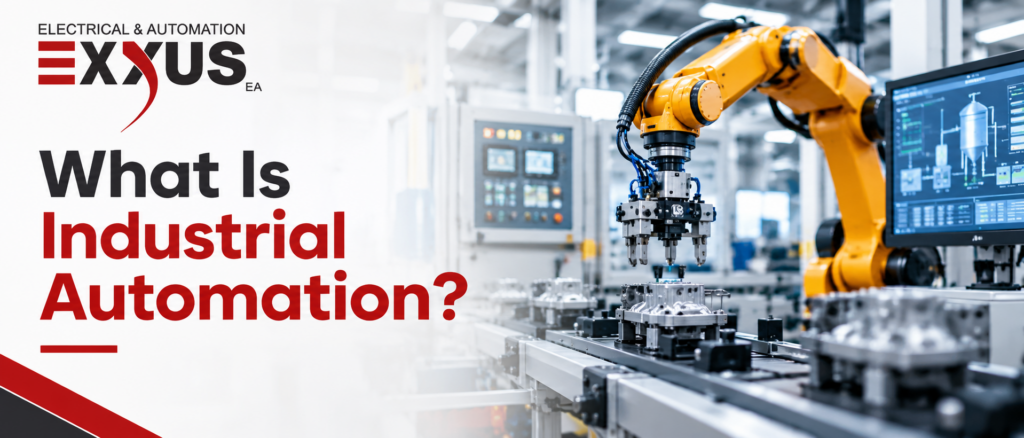
Industrial automation is the use of control systems, sensors and machines to run a production process with very little hands-on input. Picture a bottling line that fills, caps and labels thousands of bottles an hour while the operator keeps an eye on a screen.
It matters more to Australian manufacturers every year. Wages are high, skilled tradespeople are hard to find, and customers still expect every product to come out the same.
We’re Exxus Electrical, and we work on these systems every day. So this guide covers how they work, what’s inside them and how you can start without overspending.
What Is Industrial Automation?
Put simply, industrial automation means industrial control systems run your machinery for you. A controller reads data from sensors, follows the logic it’s been given and tells the equipment what to do next.
What makes it work is the feedback loop. The system measures what’s happening, compares it to the target and corrects itself on the spot. With a manual process, someone has to notice the problem first. With automated production systems, the controller notices within milliseconds.
It also scales. Sometimes it’s a single pump that starts and stops from a level sensor. Other times it’s a fully automated manufacturing plant where machines, software and data all talk to each other.
If you’d like a local history of how PLCs, SCADA and drives changed Australian plants, Manufacturers’ Monthly has a good read on it.
Industrial Automation vs Robotics
Robotics is just one piece of industrial automation. A robot arm does a physical job like welding or palletising. Automation is everything around it: the sensors, the PLC, the safety circuits, the network and the software that tells the robot when to move.
A simple way to remember it is that robots are the muscle and automation is the brain and nervous system. Plenty of fully automated lines don’t use a single robot. Most conveyor, pumping and batching systems are good examples.
How Industrial Automation Works: From Sensor to Action
Every automated system follows the same cycle: sense, process, decide, act and monitor.
Sensors gather data, the controller works through it, outputs trigger the equipment, and the system checks the result right away.
Sense → Process → Decide → Act → Monitor → repeat
A PLC runs through this loop in scan cycles that usually take just a few milliseconds. That speed is how automated lines hold tolerances nobody could manage by eye.
A Simple Conveyor Automation Example
Take a bottling conveyor. When a bottle arrives at the filling station, this is what happens:
- A photoelectric sensor spots the bottle and signals the PLC.
- The PLC checks the safety interlocks and the fill recipe.
- It tells a VFD to slow the conveyor motor.
- A pneumatic fill valve (the actuator) opens for the exact fill time.
- The HMI shows the count and flags any alarms to the operator.
- The conveyor speeds up and the next bottle rolls in.
All of that takes a fraction of a second, and it repeats thousands of times a shift.
Types of Industrial Automation
Most systems fall into one of four types: fixed, programmable, flexible or integrated. Which one suits you depends on how much you make and how often your products change.
| Type | Best for | Changeover effort | The catch |
| Fixed | One product at very high volume | Very high, often a rebuild | Cheap per unit, but you’re locked in |
| Programmable | Batch production | Moderate, reprogramming plus mechanical setup | Downtime between batches |
| Flexible | Many product variants | Low, often just a recipe change | Higher upfront engineering |
| Integrated | Whole site coordination | Low | Needs strong networks and cybersecurity |
Fixed or Hard Automation
Fixed automation is custom-built equipment made to produce one thing, very fast. You get low unit costs and great speed, but changing the product usually means major rework.
Programmable Automation
With programmable automation, you load a new program between batches to change what the machine does. It works well for food mixing or machining, although you’ll lose some production time on every changeover.
Flexible Automation
Flexible systems switch between product variants with almost no downtime, because the changes happen through recipes and settings in the control system. They suit plants that run lots of different products.
Integrated and Connected Automation
Here, PLCs, HMIs, SCADA, MES and business software all link up as one system. Production data flows from the shop floor to the office, so managers can see how the whole site is performing.
The Core Components of an Industrial Automation System
Every system, big or small, is built from the same six building blocks: sensors, controllers, actuators, operator interfaces, networks, and panels with safety systems. Here’s what each one does.
Sensors and Instrumentation
Sensors measure things like temperature, pressure, level, flow and position, then convert them into electrical signals. If the sensors are poor, the controller is basically working blind.
PLCs and I/O Systems
A PLC (Programmable Logic Controller) is the rugged industrial computer that runs your control logic. It reads inputs through I/O modules, runs the program and switches outputs on or off. Programs are written in standard IEC 61131 languages such as ladder logic.
Actuators, Motors and VFDs
Actuators turn control signals into movement. Valves, cylinders and motors do the physical work, and a VFD (variable frequency drive) sets how fast a motor runs. On pumps and fans, slowing a motor by 20% can cut its energy use by roughly half, which is why drives pay for themselves so often.
HMI and SCADA Systems
The HMI is the touchscreen at the machine, where operators start, stop and adjust things. SCADA sits above that and pulls data from many PLCs into one place for trends, alarms and reporting.
Industrial Communication Networks
Sensors, PLCs, drives and servers all swap data over industrial networks. Protocols like EtherNet/IP, PROFINET and Modbus TCP are built to keep that data moving reliably, even in electrically noisy plants.
Control Panels, Power and Safety
Control panels hold the power supplies, protection devices and wiring that keep everything running. Safety circuits, such as emergency stops and light curtains, should be kept separate from normal control logic. If you want the regulatory background, Safe Work Australia’s code of practice on managing risks of plant is worth a look.
Key Benefits of Industrial Automation
The big wins are higher output, steadier quality, safer work, less downtime and better data. You’ll usually see them first wherever the work is repetitive or hazardous.
Higher Productivity
Automated equipment keeps a steady pace with no fatigue and no slow shift handovers. That means more throughput and shorter cycle times.
Better Quality and Consistency
A machine repeats the same action the same way, every time. Add vision systems and inline checks, and defects get caught before they reach a customer.
Improved Workplace Safety
Heavy lifting, hot work and chemical handling can all move to machines. Fewer people in danger zones means fewer injuries.
Reduced Downtime
Alarms and diagnostics flag faults early. Vibration and temperature data also support predictive maintenance, so you can replace a worn bearing before it takes the line down.
Better Data and Process Visibility
Automation records what your plant is really doing. Downtime reasons, scrap rates and energy use become numbers you can act on instead of guesses.
More Effective Use of Skilled Workers
Your best people spend less time on repetitive jobs. They can put that time into maintenance, troubleshooting and improving the process.
Where Industrial Automation Is Used
You’ll find industrial automation applications in nearly every sector that makes, moves or treats a product. A few common ones:
- Mining and resources: conveyor monitoring, crushing circuits and remote pump stations
- Food and beverage: batching, filling, cold storage controls and washdown lines
- Water and energy: treatment plants, pumping and telemetry
- Warehousing and logistics: sortation, conveyors and palletising
- Manufacturing: assembly, packaging and machine control
You can see the kind of work we do in our project gallery.
A Practical Approach to Adopting Industrial Automation
The smartest way in is to start with a clear problem, measure it, then scale in stages. Jumping straight to hardware is the most common and most expensive mistake we see.
Start With the Operational Problem
Work out the exact bottleneck first. It might be repetitive handling, frequent breakdowns, scrap or a safety risk. Talk to the operators who run the machine every day, because they usually know where the pain is.
Measure the Existing Process
Record a baseline before you change anything. Track output, cycle time, downtime and error rates. Without those figures, you can’t prove the project worked.
Choose the Right Level of Automation
You don’t have to automate everything at once. A single VFD, sensor upgrade or PLC retrofit can deliver a quick win, and you can build from there once it’s proven itself.
Assess Existing Equipment and Integration
Take stock of what you already have. Many older machines can connect to modern controllers through gateways or retrofits, which often costs far less than replacing them. Check the wiring, communications and safety circuits while you’re at it.
Test, Commission and Train
Test everything before it goes live. A Factory Acceptance Test (FAT) proves the logic works before delivery, and commissioning proves it on your site. Operator training and handover documentation then help the results stick.
Measure the Results
Compare performance against your baseline. That shows your return on investment and usually points to the next thing worth improving.
Before You Automate: Key Factors to Consider
Before you commit, look closely at total cost, integration effort, your team’s readiness and cybersecurity. These are the points that most often decide whether a project succeeds:
- Total cost of ownership: include maintenance, spare parts, licences and training, not just the purchase price.
- Future scalability: pick a platform you can expand later.
- Safety and compliance: the design should meet AS/NZS 3000 and relevant machine safety requirements.
- Cybersecurity: connected systems bring new risks. The Australian Cyber Security Centre publishes guidance on protecting operational technology environments.
- Local support: choose a partner who can get to site quickly when something fails.
How Exxus Electrical Supports Industrial Automation
We design, build, program and support control systems for industrial sites across Perth and Western Australia. Our PLC programming and control system services cover turnkey solutions, programming on Allen-Bradley, Siemens, Omron, Mitsubishi and WAGO platforms, HMI and SCADA design, and legacy upgrades.
We also build control panels and switchboards, run in-house and witnessed FATs, handle site commissioning and train your operators. And as a licensed electrical contractor, we offer 24/7 emergency fault response.
Ready to Automate? Talk to Exxus Electrical
Whether you’ve got a PLC fault to fix, an ageing panel to upgrade or a new control system to design, our team at Exxus Electrical is happy to help.
We’ll look at your process, explain the options and recommend the smallest upgrade that solves the problem.
Request a no-obligation quote and let’s talk through your project.
Frequently Asked Questions
How much does industrial automation cost in Australia?
Costs scale with scope. Upgrading one PLC or drive is a small project, while integrating a full line is a major investment. An onsite assessment gives a realistic figure.
Will industrial automation replace human workers?
It mostly changes roles rather than removing them. Repetitive and hazardous tasks move to machines, while people shift into programming, maintenance, quality and process improvement.
Is industrial automation worth it for small manufacturers?
Yes, if you target a clear problem. Small upgrades such as a PLC-controlled conveyor, VFD or automated batching often pay back faster than a full line rebuild.
How long does an industrial automation project take?
Small upgrades can take weeks, while larger integrations run for months. Design, programming, panel build, factory acceptance testing, commissioning and training each add time.
What is the difference between industrial automation and Industry 4.0?
Industrial automation controls machines. Industry 4.0 connects those machines to data, analytics and business systems, so the whole operation can be optimised, not just single machines.